How to Choose the Best Coffee Beans for Your Taste, Part One: Roast Level
How to Choose the Best Coffee Beans for Your Taste, Part One: Roast Level
Part one of a three-part practical guide to roast levels, brewing methods, and flavor—by practical people who roast for a living in Albuquerque, New Mexico.
Single-origin, blends, light roast, dark roast: when it comes to choosing Specialty coffee, the choices can feel overwhelming. The good news is that there’s no wrong answer. Even if you buy something you’re not crazy about, that’s just information to help you zero in on your target.
The even better news is that we've been roasting at high altitude in Albuquerque since 1993, and we’ve achieved high scores from third-party reviewers and won competitions with single origins, blends, light roasts, and dark roasts. We’ve got something for everyone.
This guide discusses various marketing terms for roast levels, how the professionals evaluate coffee when we need to know what to buy, and how brew method affects flavor. Read through for tools and information that will help you buy coffee that makes you happy every time.
In today’s post, we tackle roast level.
What roast level is right for you?
Roast level is one of the two most important factors in how your coffee tastes (the other being the coffee’s region of origin and origin processing).
Roast level is often described in color terms, and since roast color can be reliably measured using a spectrophotometer, that’s one useful way to think of it. But roast level is also an indicator of how long the coffee beans spent in the roaster (machine) before the roaster (person) decided they were done.
Consider toasting bread: some people like their toast just barely golden brown and still soft on the inside, and others prefer a crunchy brown brick. When toast is in the toaster for a longer time, it gets darker in color, dries out, and develops more toasty/burnt flavors. This is also what happens to coffee as it spends more time in the heat of the roaster, and like toast, it undergoes chemical processes like the Maillard reaction and caramelization, which are both responsible for coffee turning from green to brown.
Light-roasted coffee spends less time in the roaster, dark roasts spend more time. Flavor, acidity, and body can all be dramatically influenced by the timing and degree of heat applied during the roasting process. The character of our roasts tends to break down along these lines:
Light roast
Bright (meaning more acidic), fruity, green aromatics. Light roasts preserve origin character well. They also happen to be what Specialty coffee professionals use for cupping, because dark roasting can mask origin character and/or defects in the raw product. If you like rooibos, chardonnay, or hoppy IPAs, light roasts might be a good fit.
Medium roast
Balanced, retains lots of origin character, has a little caramelly sweetness. If you're not sure where to start, start here. Medium roasts split the difference between bright acidity and roast-forward flavor and we often find that origin character can be enhanced with just a little more development time than a light roast. Think: Merlot, milk chocolate.
Dark roast
Intense, a little toasty-burnt-sugary, with less acidity. More of the flavor comes from the roast itself rather than the origin, when compared to a light or medium roast. Strong, assertive, can be great for espresso drinks, especially milky ones, and cold brew. If you like a porter, Malbec, and/or dark chocolate, dark roasts are probably up your alley.
Where does Red Rock fall on the spectrum of Specialty coffee?
We happen to have recently been featured in Coffee Review’s May-June article, What Are the Best Dark Roast Coffees Now? 10 Picks for 2026. Kim Westerman writes,
“We received close to 200 samples for this report and cupped them blind, as usual, in no particular order. And, as it turned out, when we took Agtron readings of the top-scoring 10 for review, we found that every one landed in the same average Agtron range of 44 to 47 — meaning that each was pulled from the roaster at the cusp of second crack, or just into it.
… Second crack marks a chemical inflection point: Cell walls fracture more deeply, CO₂ escapes rapidly and caramelized sugars begin to carbonize. Oils migrate to the surface. Origin character — the volatile aromatics that express terroir, variety, and process — starts its long fade.”
Agtron is the name of the spectrophotometer used in the coffee industry, and the higher the Agtron number, the lighter the roast. Our dark roasts read between Agtron 44 and 48 or so—which is just a hair darker than the publicly available Agtron readings for what a certain large multinational coffee retailer refers to as “blond.” Likewise, we don’t consider coffees developed when they’re just beginning first crack—a light roast benefits when more of its starches become sugars and its acidity softens, for example.
Because we don’t think the extremes of baked or burnt taste very good, we’re painting with a very small paintbrush over here. As Westerman put it, our French Roast is “executed with the conviction of restraint,” which sounds really good, right?
The Upshot
Knowing all this, how can you choose well for yourself?
If you absolutely can’t stand bitterness, we recommend a light or medium roast. If you love a bittersweet dark roast but don’t like sourness at all, you should choose a dark!
We do offer a sampler pack that includes two of our medium roasts (one fruity, one nutty) and our most popular dark roast. That way, you can try our different styles without a big commitment.
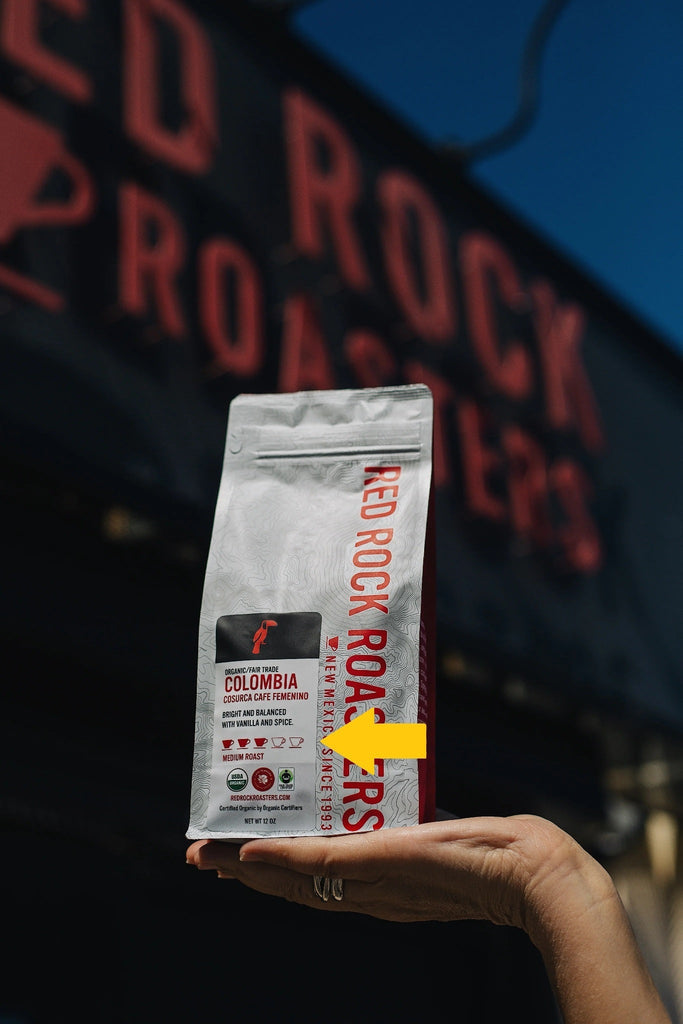
Our coffee labels have a roast meter, as shown:

And while looking at color on a screen is not particularly accurate, here is a photographic guide to what we mean when we use certain roast terms in product descriptions:

Where can I buy Red Rock Roasters coffee?
Online at redrockroasters.com, and in stores throughout New Mexico. We ship nationally.
Red Rock Roasters is a family-owned Specialty coffee roaster based in Albuquerque, NM. Our coffees regularly earn high scores — which means we spend a lot of time thinking about what makes a great cup, and then making it. For you. We're not shy about sharing.